Frequency range
Ask for the sine upper frequency and the square or pulse upper frequency separately. A 60 MHz sine note does not mean the square output reaches the same point. Record the unit as Hz, kHz, or MHz on the line.
Independent sourcing partner
LinkScope Sourcing 56 helps a US buyer write a function generator calibration brief, then asks factories to quote the same waveform, load, and evidence set. The desk does not stock instruments and does not decide whether a source is in tolerance.
A usable line names the waveform, the frequency range, the amplitude into a stated load, and whether a current certificate must travel with the serial number. Example fields to request, not results published here: sine to 60 MHz into 50 ohm, a 10 MHz reference input, and a frequency accuracy the datasheet states in ppm.
Request Factory Quotes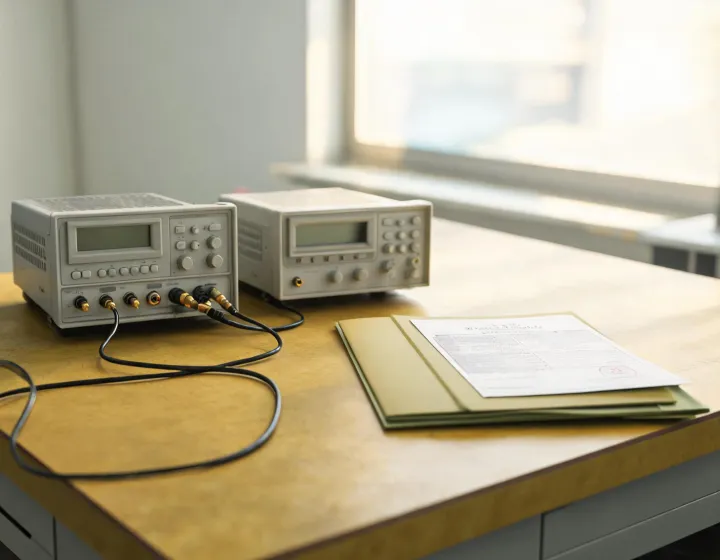
Each card is a field the supplier fills for the exact model. A family photo does not fill the cell. Measurement accuracy and calibration traceability stay attached to that model and that certificate date.
Ask for the sine upper frequency and the square or pulse upper frequency separately. A 60 MHz sine note does not mean the square output reaches the same point. Record the unit as Hz, kHz, or MHz on the line.
Output impedance is commonly requested at 50 ohm. Amplitude into 50 ohm is often about half the open-circuit figure. Ask the supplier to state both, for example 10 Vpp into high-Z and the matching figure into 50 ohm, plus DC offset such as ±5 V if the brief needs it.
One output, two outputs, or four outputs changes the clock plan. A 4 channel function generator quote belongs on the channel checklist. A second box plus a splitter is a deviation, not a silent substitute.
Ask whether the certificate names the serial, the date, the interval (12 months is a common request, not a site rule), and the lab. An uncalibrated function generator 60mhz card on the inquiry list must stay on its own price line.
A lab may use the source to check a counter or a receiver chain. Request frequency accuracy in ppm, amplitude flatness across the stated frequency range, and whether a 10 MHz reference is included. VSWR or return loss of the output match is a datasheet field, not a number this page measures.
A rack unit of bench gear still needs the mains voltage, the BNC or N connector, and the connector mating cycle if the sheet prints one. Gain here means the amplitude setting, not an antenna gain. Channel width and MIMO belong to a radio brief, not to this waveform line.
A function generator xr2206 kit is a different class from a calibrated 60 MHz bench source. The XR2206 IC family is widely documented from 0.01 Hz to more than 1 MHz. The kit quote must still state the builder supply, often discussed around 9 V or 12 V, and whether a case and BNC are in the box. Read the kit application page before mixing the two prices.
If the source leaves the bench, ask for runtime on battery, ingress protection if the sheet has one, and the safety standard named on the model, often IEC 61010 for lab gear. Do not copy a CAT III rating from a clamp-meter brief onto a low-voltage waveform output.
A calibrated shipment can include a certificate whose interval the supplier states, such as 12 months, plus the as-found and as-left language if the lab prints it. A bare instrument can be cheaper to move and still need a local calibration before use. Compare those two lines after freight, not as one price.
A new unit can carry a clearer support path and a fresh calibration start. A refurbished unit can cover a discontinued waveform family when the seller states condition, remaining calibration, missing accessories, and warranty length. Those documents are the comparison, not a headline.
Three items stay open until the supplier writes them for the exact item: output match into the buyer load, FCC or NRTL status when that evidence applies to the model, and delivered cost after freight and calibration. ISO 9001, if offered, is a supplier quality-system file, not a waveform result. IEEE 802 and 47 CFR Part 2 are question sources. They do not certify a generator.
Manufacturer, model, waveforms, load, adapters, and calibration inclusion repeat on every factory reply.
Quantity, currency, per-unit or whole-order budget, US destination, and requested timing sit beside the price.
BNC leads, arbitrary-waveform software, racks, and training are separate lines unless the quote includes them.
Read the procurement brief, then send the requirement. The drawing itself is not uploaded here. FREE sourcing support of up to 3% is described in the banner, with eligibility confirmed after product, quantity, destination, and sourcing requirements are reviewed.
Request Factory QuotesQualified briefs can include sourcing support of up to 3%.
Eligibility applies to qualified business buyers and is confirmed after we review your product, quantity, destination, and sourcing requirements.
Prepare a Telecom RFQ