Quote scope before an alternate is accepted
An alternate model is acceptable when the open cells below are answered, not when the price is lower on a thinner scope. Record each cell as mandatory, preferred, or unknown.
| Cell | Professional bench request | Why it blocks an alternate |
|---|
| Frequency range | Sine upper limit and square upper limit, written separately | A 60 MHz sine claim can hide a 10 MHz square limit |
| Impedance | 50 ohm, or another stated value | A 600 ohm output will not match a 50 ohm radio test port |
| Amplitude | Vpp into the stated load, plus DC offset if needed | Open-circuit volts overstate the delivered level |
| Channels | Count and whether one clock is shared | Four boxes are not a 4 channel function generator |
| Edges | Rise time at a stated amplitude | A slow edge fails a digital timing check |
| Evidence | Certificate date, interval, serial | A family brochure is not calibration traceability |
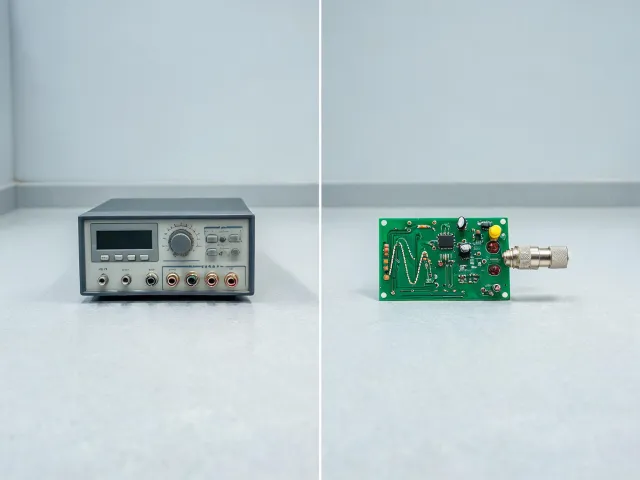
Background: a buyer had shortlisted a cased source and a function generator xr2206 kit under the same professional label. The process was to require a certificate serial and a 50 ohm amplitude note for the professional column. The result was that the kit moved to a training column with supply voltage 9 V or 12 V, and the bench column kept a request for frequency accuracy in ppm.
Harmonic content belongs in the professional column when the sine feeds a receiver test. Ask for THD or harmonic level at the frequency the sheet uses. A figure such as under 0.1 percent is meaningful when the conditions are printed. Without conditions, leave the cell open. VSWR and return loss describe the output match. They are optional unless the brief drives a 50 ohm analyzer.
Arbitrary waveforms add sample rate and memory depth. A 16-bit or 14-bit vertical word, if the sheet states one, changes the amplitude steps. Software that builds the waveform is a license line. Gain in this checklist means the amplitude control, not antenna gain. Channel width, MIMO, optical budget, wavelength, insertion loss of fiber, and dispersion are out of scope unless a cable between the generator and the device is long enough that coax loss must be estimated.
Safety and environment: request the standard printed on the model, commonly IEC 61010 for bench instruments, the mains range, and operating temperature if the sheet has it. Ingress protection and runtime apply to a portable professional unit, not to a rack unit that stays on mains. Connector mating cycle is worth a line when BNCs are patched every shift.
Commercial scope sits under the technical cells. Quantity, currency, per-unit or whole-order budget, destination, timing, freight, and calibration labor are separate. High-end, mid-range, budget, or undecided records a preference for finish and support. It does not verify the factory. New versus refurbished, and OEM-marked versus compatible, stay as open disputes until documents arrive. A lower refurbished price with a shorter remaining calibration is not the same offer.
IEEE 802 and ITU-T fiber texts do not define this waveform source. 47 CFR Part 2 is a question source if the finished instrument needs equipment authorization. Applicability is for the exact model. This checklist does not certify it. Supplier ISO 9001, FCC, or NRTL files are requested when the seller cites them, and they are read against that model.